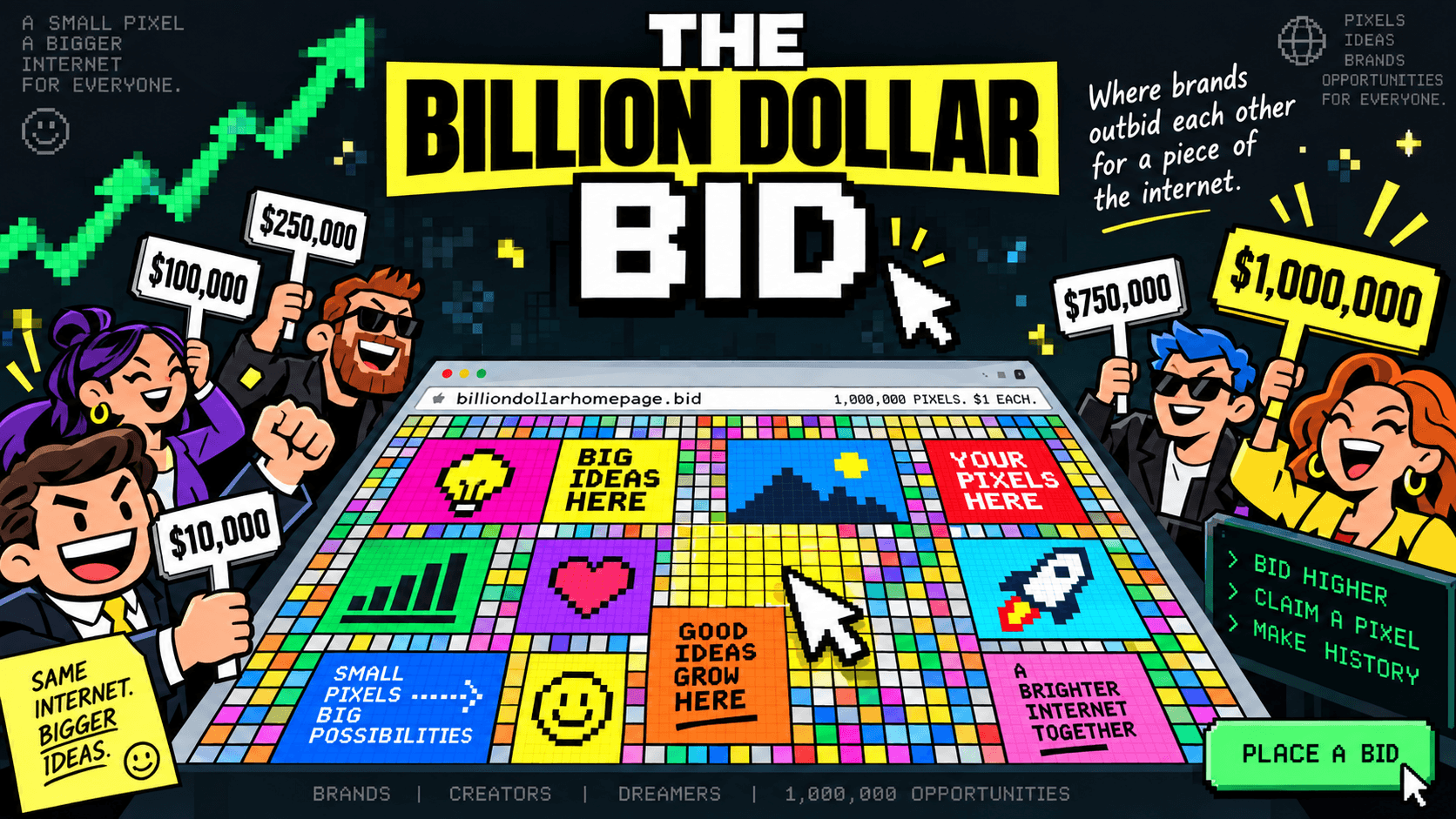
How a client report, a 21-year-old internet idea and a very simple bidding rule turned into my latest experiment
I was in the doghouse and supposed to be doing client reports.
Instead, somewhere between checking search rankings and working through another spreadsheet, I was listening to The Next New Thing podcast. They mentioned the Million Dollar Homepage, and a little trapdoor opened in my memory.
I remembered the site immediately.
Back in 2005, I thought it was completely mad and a stroke of genius at the same time. I was not properly earning my living online until a few years later, so I was very much an observer rather than a participant. But some internet ideas lodge themselves in your brain because they are so easy to understand that you never really forget them.
The original Million Dollar Homepage was a 1,000 x 1,000 pixel webpage. It was divided into advertising space and the pixels were sold for $1 each. The minimum purchase was 100 pixels. Buyers supplied an image, a link and some hover text. The final 1,000 pixels were eventually auctioned on eBay, taking the project's reported gross revenue to $1,037,100.
That was basically it.
No elaborate platform. No complicated business model. No pitch deck explaining a new category of digital ecosystem.
One million pixels. One dollar each.
Brilliant.
Twenty-one years later, I started wondering what would happen if you made those pixels fight back.
The best ideas aren't always complicated
The podcast had also put Outbid.lol on my radar.
Outbid launched in August 2026 around another beautifully simple proposition: pay more and move higher on a public leaderboard. Its creator describes it as a side project where “rank is what you pay”, and the simplicity helped it attract attention, revenue and a small army of copycats almost immediately.
That was the bit that interested me most.
Not because I wanted to build another Outbid clone.
Quite the opposite.
There is a tendency, particularly among entrepreneurs and people building technology products, to keep adding things until an idea looks sufficiently clever.
We invent dashboards for dashboards.
We add AI because everyone else has AI.
We add community features nobody asked for, complicated pricing tiers, badges, tokens and enough settings to make launching a nuclear submarine feel straightforward.
Sometimes complexity is necessary.
Sometimes it is just vanity.
I've always liked the K.I.S.S. principle: Keep It Simple, Stupid.
If you cannot explain an internet business relatively quickly, you have already made the job of distributing it harder.
The Million Dollar Homepage passed that test spectacularly.
Outbid passes it too.
So instead of reinventing either wheel, I started wondering what would happen if you bolted one wheel onto the other.
What if the pixels were never really sold?
The fundamental weakness of the original Million Dollar Homepage was also part of its brilliance.
It had an ending.
Once all one million pixels were sold, that was essentially game over.
The page remained online, but the economic event was finished.
What if it didn't have to finish?
That became the germ of the Billion Dollar Homepage.
The canvas remains 1,000 x 1,000 pixels.
Pixels still start at $1 each.
The minimum purchase is still a 10 x 10 block, so $100 gets you onto the wall.
You upload an image and a website address. Your block appears on the homepage.
Then comes the change.
Someone else can take it.
They simply have to pay at least 5% more.
Hence the tagline:
Where brands outbid each other for a piece of the internet.
And the slightly more ominous version on the How It Works page:
Buy pixels. Stay until you get outbid.
That single rule completely changes the life expectancy of the original idea.
There are no final pixels.
There is no closing bell.
The same patch of internet can theoretically change hands forever.
Why a billion dollars?
This part is mostly a joke.
Mostly.
When I was a kid, a million dollars sounded like an almost mythical amount of money.
A millionaire was properly rich.
Billions were figures you encountered in discussions about entire countries or the occasional oil baron.
Trillions weren't really part of everyday vocabulary at all.
That has changed rather dramatically.
The US federal debt first crossed $1 trillion in 1981, almost two centuries after federal debt began accumulating in the country's early years. In August 2026 it crossed $40 trillion. In roughly the year leading to that latest milestone, around another $3 trillion had been added.
Whether you see that primarily as inflation, fiscal policy, currency debasement, economic growth, government profligacy or some complicated combination of all of them is a much bigger conversation and why I swap paper for gold.
But psychologically, our relationship with large numbers has clearly changed.
Million.
Billion.
Trillion.
What's next? A Quadrillion!!
This time next year maybe we'll all be billionaires Rodney!
Not because we're fantastically richer, but because the fiat debt instrument we're measuring everything in has become worth-less.
So calling this the Billion Dollar Homepage amused me.
Calling it the Inflation-Adjusted $1.7-Something-Million Homepage didn't have quite the same ring to it. Besides, the domain name wasn't available!
And I certainly do not need a billion dollars.
At this stage of life, I'm not a particularly enthusiastic consumer. I'm content with what I have.
If someone deposited a billion dollars into my account tomorrow, I'd probably spend the first week wondering what on earth I was supposed to do with it. Not because I have no imagination, but because I'm wealthy in ways no amount of money can buy.
So maybe some new boots and panties wouldn't go amiss.
Then, I would get all analogue, get my hands dirty and buy tracks of land, plant lots of native trees and fruit trees so the locals would always have access to good, clean healthy organic food.
The billion is the target because the target is ridiculous.
The ridiculousness is part of the project.
Planting trees is my passion.
So why keep the pixels at $1?
If we're acknowledging 21 years of inflation, surely the pixels should cost more?
I considered it.
Then decided against it.
The $1 starting price belongs to the original idea.
More importantly, it keeps participation relatively democratic.
One grid unit contains 100 pixels, so the minimum spend is $100.
A startup can afford that.
A local business can afford that.
A band can chip in together and afford it.
A football club, online community or group of mates could buy a block simply because they fancy becoming part of the experiment.
The expensive pixels can become expensive later if people decide they are worth fighting over.
The rich can scrap over the prime positions.
Everyone else can still get through the front door for a hundred bucks.
That feels about right.
The 5% rule
The bidding mechanism needed to be equally simple.
No complicated auctions.
No closing times.
No combination of percentage increases and fixed-dollar increments.
To take an occupied block, your bid must be at least 5% higher than the current value.
But there is another important part.
If you previously held that block, the money you already spent remains credited.
Suppose Coca-Cola has $10,000 invested in a block.
Pepsi comes along and takes it for $10,500.
Coca-Cola doesn't need to find another $11,025 from scratch to get it back. Its original $10,000 remains credited. It only needs to add the difference required to beat Pepsi by another 5%.
That makes the next decision psychologically very different.
You are no longer asking:
“Would I spend eleven grand on this?”
You are asking:
“Would I spend another thousand or so to kick Pepsi out?”
Rage.
Envy.
Ego.
Corporate tribalism.
All the noblest human emotions.
I'm joking, of course.
A bit.
Competition is enormously powerful. Coke and Pepsi, Apple and Microsoft, Samsung and Apple. Great rivalries help define both sides. Neither competitor would be quite as interesting without the other.
Who doesn't want to be number one?
And who enjoys seeing a competitor sitting where they think they belong?
This is advertising with a little spectator sport mixed in.
We live in the attention age
The pixels are not really the product.
Attention is.
That's what advertisers have always bought, whether the medium was a newspaper, a billboard beside a motorway, a television break, a Google search result, a podcast sponsorship or an influencer waving a protein shake at a camera.
The Billion Dollar Homepage is advertising first.
Entertainment comes second.
But ideally one reinforces the other.
If nobody visits the page, the pixels aren't particularly interesting.
If people visit because they want to watch what's happening, those pixels become more useful to advertisers.
If advertisers start fighting over them, something interesting happens.
If something interesting happens, people talk about it.
If people talk about it, more people visit.
Traffic creates advertising value.
Advertising value creates bidding.
Bidding creates stories.
Stories create traffic.
That's the loop I'm interested in.
Hold on to your pixels, whatever the cost.
The scoreboard is part of the show
This is also why I want the transactions to be public.
If someone takes a block from someone else, I don't want that disappearing into a private database.
The history is part of the site.
Who bought it?
Who took it?
What did they pay?
How many times has that particular block changed hands?
How much money has it generated during its lifetime?
Who keeps coming back?
How long did somebody manage to hold onto it?
A bidding war without a scoreboard is just an argument.
A public record turns it into entertainment.
It also gives journalists something useful.
Imagine two recognisable technology companies fighting repeatedly over the same patch of the homepage. The site should make that history transparent enough that a journalist can see the entire battle without ringing me up for a spreadsheet.
The transparency itself becomes marketing.
Who doesn't love a good tale?
Or, to borrow a line from Gladiator:
Are you not amused?
Fixing one thing the original could not
There is another advantage to having a living wall.
The original Million Dollar Homepage has suffered from link rot.
Companies disappear.
Domains expire.
Businesses change hands.
Some destinations become irrelevant or potentially unsafe.
That's hardly the original creator's fault. It is what happens to a webpage after two decades.
But a modern version can do better.
Destination URLs can be monitored.
Dangerous links can be disabled.
Advertisers can update legitimate destinations.
Every change can be recorded.
And, most importantly, somebody else can eventually outbid a dead position and bring that part of the wall back to life.
The historical record remains.
The live advertising keeps moving.
I'd love eventually to be able to rewind the whole thing and see exactly what the Billion Dollar Homepage looked like on a particular day in 2026, 2027 or 2030.
If it survives that long.
Time will tell.
We nearly invented the metaverse again
There were other versions of this idea along the way.
I considered niche versions.
I considered something closer to the digital land rush we saw around Decentraland, The Sandbox, Otherside and NFTs.
People made serious money from that period, but much of the grand vision of people permanently inhabiting scarce virtual property never really became normal behaviour.
The more I thought about it, the clearer the answer became.
Don't turn pixels into speculative property.
Don't create some elaborate fiction about digital ownership.
Don't add tokens.
Don't promise that today's $100 patch of coloured squares will become tomorrow's beachfront property.
Keep it advertising.
You pay.
You get the attention while you occupy the space.
Someone wants the position more than you do, they pay more.
Simple.
There is a lesson in there that goes well beyond this project.
When an idea starts making sense, sometimes the next job isn't adding features.
It's removing them.
AI changed my ability to act on ridiculous ideas
There is another reason I could actually build this now.
A few years ago, I couldn't have.
Not on my own, anyway. I have short arms and deep pockets.
I'm an ideas person.
And just like my best suit, ideas are cheap.
Everyone has ideas.
Execution is where most of them die.
AI has dramatically changed the cost of execution for someone like me.
I can design systems, work through logic, troubleshoot code, build interfaces and connect pieces together in ways that would previously have required considerably more technical assistance, money and and the greatest commodity of all, time.
I'm building locally, experimenting with different models and using the tools available to me rather than waiting for someone else's perfect technology stack.
That does not mean AI magically builds businesses.
Nothing is as simple as the YouTube gurus make it sound.
There are always more moving parts than you expected.
Something breaks.
Then something else breaks because you fixed the first thing.
The sensible approach is the same one that worked before AI: break the project into manageable chunks, make incremental progress every day and keep moving.
Then go outside.
Walk in nature.
Play with the dogs.
Give your subconscious a chance to untangle whatever your conscious mind has spent three hours making worse.
The tools have changed.
Some of the fundamentals haven't.
Building has become easier. Finding an audience hasn't.
This is probably the biggest risk with the entire experiment.
The technology isn't the hardest part anymore.
Attention is.
You can build a clever app in a few days and discover that precisely seven people care, three of whom are relatives.
New SaaS products, apps and AI projects appear constantly.
Most will never find a meaningful audience.
There is always a chance I'll build the Billion Dollar Homepage and nobody comes. I didn't build in public or have time to create a marketing campaign.
But there is a 100% chance of having no audience if you don't build it in the first place.
So I'll take the other odds.
My definition of success in the first month is not remotely close to a billion dollars.
I want eyeballs.
I want people interacting with it.
I want somebody to see the idea and immediately understand why it might be fun.
Media attention would excite me enormously.
If it made four figures in its first 30 days, I'd be tickled multiple shades of pink.
After a year, success would look more like consistent or growing traffic, regular interactions and enough bidding activity that the page feels alive.
Beyond that?
Ask me in a year.
Who actually buys the pixels?
I suspect startups, technology companies, apps and online businesses will make up much of the early wall.
They're already accustomed to trying strange things for attention.
But I hope we get surprises.
I'd love to see established bands buy pixels when they release a new album and point the block to Spotify.
I'd love to see communities club together.
I'd love to see some old internet business appear simply because the founders remember the original Million Dollar Homepage.
And yes, I'd love to see genuinely enormous brands fighting.
Apple versus Samsung.
Coke versus Pepsi.
If Elon Musk decided to buy some pixels for Tesla, a company historically famous for relying heavily on word-of-mouth rather than conventional advertising, that would probably make my week.
The better outcome, though, may be something nobody has thought of yet.
Internet users are very good at taking simple systems and using them in ways the person who built them never anticipated.
That's half the fun.
Some things are not invited
Of course, an open advertising platform requires rules.
At launch, moderation will be human.
If the project becomes busy enough, automation can handle more of the routine work, perhaps eventually reaching something like an 80/20 split between automated checking and human oversight.
But the basic exclusions aren't particularly complicated.
No pornography, malware, phishing, fraud, counterfeit brands, extremist material, hate content, illegal products, political parties, trademark impersonation, offensive imagery or Taylor Swift.
Everyone has to draw the line somewhere.
The advertising links themselves also use rel=“sponsored”. You're buying attention and traffic, not SEO link equity.
I want the advertising platform to remain useful, transparent and reasonably civilised even if the wall itself becomes visually chaotic.
Could one person really build a billion-dollar company?
There is a much bigger conversation happening around one-person companies and AI.
Could one founder, using AI systems, automation and cheap infrastructure, build a business worth a billion dollars?
I don't know.
And I'm certainly not declaring that this is one.
That would require a level of LinkedIn confidence I haven't yet achieved.
But the question itself has become less absurd.
One person can now access capabilities that once required multiple specialists.
Development.
Design.
Research.
Automation.
Content.
Analysis.
Operations.
The barrier to trying things has collapsed.
That's the opportunity I think people should be paying attention to.
Use the tools that exist today.
Build something useful for yourself.
You may discover somebody else needs it too.
Build something silly because you're curious.
You may discover thousands of other people find it amusing.
The downside can now be remarkably small.
The upside?
Well, for the purposes of this particular experiment, let's call it a billion dollars.
An overnight success, 40 years late
There's another part of this that amuses me.
I'm approaching 60.
If this thing unexpectedly catches fire, I may find myself wondering why my overnight internet success didn't arrive forty years earlier.
But that's also why I find the current moment exciting.
There are people sitting in spare rooms, garages, workshops, bedrooms, basements and little huts all over the world building things that would have required companies only a few years ago.
You're working alone, but you're not really alone.
There is a whole community of people playing with the same tools, asking the same questions and occasionally building something gloriously unnecessary simply to see what happens.
I already had a considerably bigger side-project in planning before the Billion Dollar Homepage distracted me. I think that one could genuinely shake up part of the music industry.
More about that another day.
For now, I've got pixels to sell.
Build the ridiculous thing
The Billion Dollar Homepage started because I was supposed to be writing client reports and a podcast reminded me of something wonderfully strange that happened on the internet 21 years ago.
That memory led to the Million Dollar Homepage.
The Million Dollar Homepage led to Outbid.
Outbid led to a question.
What if the Million Dollar Homepage never had to finish?
A couple of days later, I was building it.
Will the Billion Dollar Homepage make a billion dollars?
Almost certainly not.
But that's hardly the point.
If people watch it, click it, laugh at it, advertise on it, fight over it and wonder what happens next, it has already become more interesting than another sensible SaaS dashboard.
And if it somehow does make a billion dollars, I'll have to come up with a considerably better excuse for not retiring.
Trillion Dollar Homepage - Bueller, Bueller... anyone?
The Billion Dollar Homepage
Where brands outbid each other for a piece of the internet.
Buy pixels. Stay until you get outbid.